

Galvanic Corrosion: A Guide for Architecture
Everything you need to know about galvanic corrosion
If you're a designer working with exterior metals, you've probably heard of galvanic corrosion. Also known as bimetallic corrosion, its a nasty but preventable condition.
Dealing with metal corrosion? Work with our team at Poma to identify and replace corroded metal system with our products. Most architects know a little bit about Galvanic Corrosion, but what exactly causes these metals to react? And what are the best practices for dealing with it and preventing it in the future? We've put together this resource so that the next time you’re talking to someone about galvanic corrosion, you'll know as much as as the experts.

Luigi Galvini proved the existence of a biological electricity, or the galvanic current. Yet he didn't coin the term. His rival Alessandro Volta thought Galvini's science was bunk, and mocked the idea of "Galvanism". The name stuck. And Volta's name did, too — we still use "volt" to describe electromotive force. Yes galvanic corrosion can be a big deal, but in many situations, you can reduce the risk. And you can even continue to use two metals which would normally react with one other. Keep reading to learn when it matters and when it doesn't. (And scroll down for a mnemonic device for galvanic series to help you remember the most common metals.)
Galvanic Corrosion Terminology Defined
First, let's define some of the terminology: Galvanic Corrosion: Named for Luigi Galvani, galvanic corrosion occurs when base metals make contact with noble metals. Galvini discovered that chemical reactions can create an electrical current. Hence, this process is called galvanism. When this galvanic current is completed by an electrolyte, you get galvanic corrosion. Nobility: Noble metals resist corrosion, while base metals tend to corrode. The use of the word "noble" in chemistry dates back 1906. Scientists borrowed the term to describe inert gases, or elements that don't react. So think of a noble metal as having a high moral character — these metals stand their ground. Noble metals will not corrode against other metals.
Many forms of moisture including rainwater and seawater contain electrolytes, which serve as the conductor for galvanic corrosion. Imagery courtesy of 20th Century Fox. Electrolyte: Substances that give ions when dissolved in water are called electrolytes. Most forms of moisture contain electrolytes, which are divided into acids, bases, and salts. Electrolytes act sort of like a wire connecting an electrical circuit between two metals, enabling galvanic corrosion. Cathode (+) and Anode (-): When two metals make electrical contact, they each become polarized. This relationship is measured in volts. The positive metal acts as a cathode (receiving ions) and the negative metal acts as an anode (losing ions and corroding). We'll explore each of these concepts further, but first let's look at Galvanic Series Chart. This chart will help you to determine which metals are more noble than other metals.
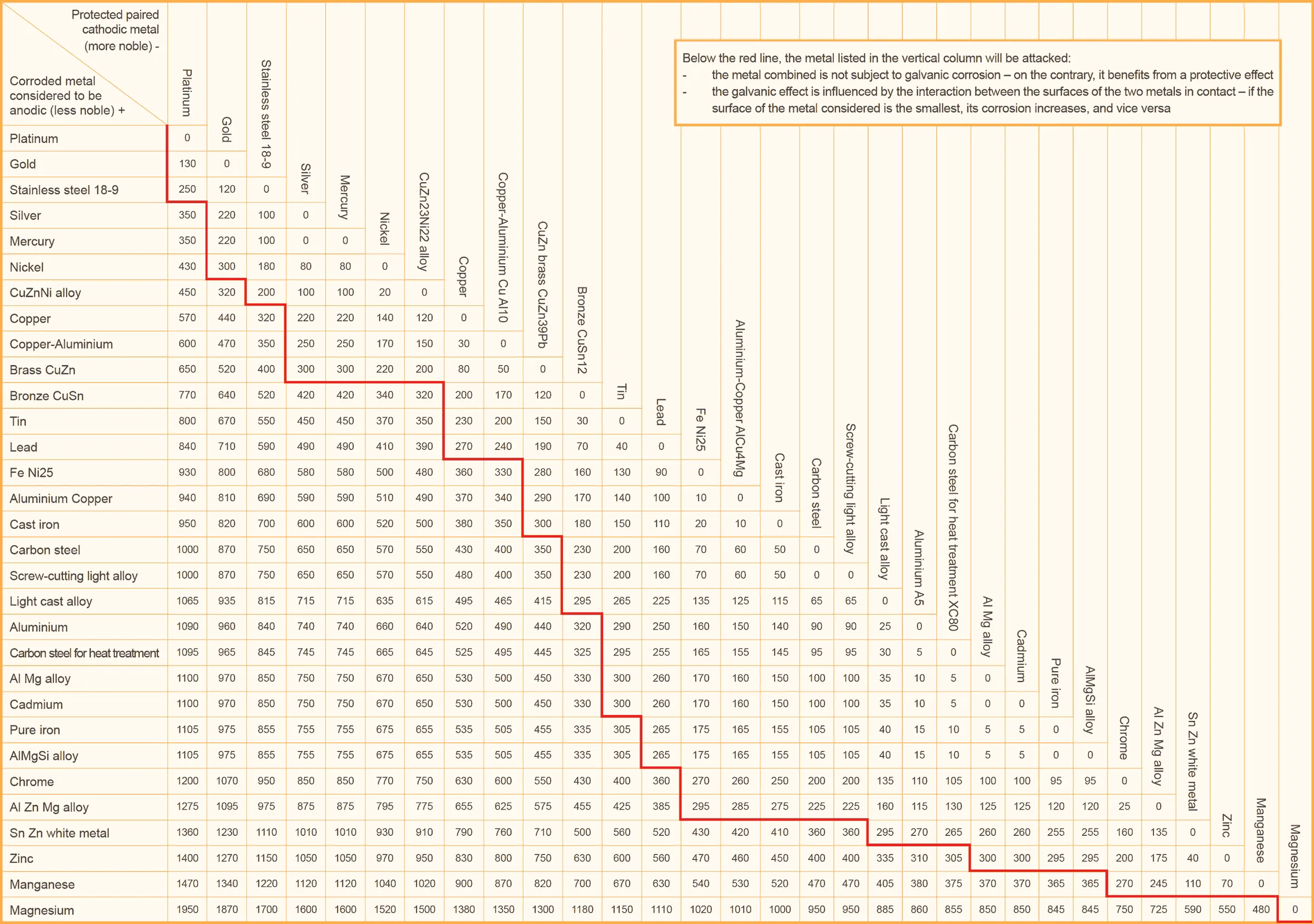
Galvanic Series Chart — determine metal nobility and bimetallic corrosion. Chart courtesy of LaClusienne.
Galvanic Series Chart for Architectural Metals
Most galvanic corrosion charts show a huge range of metals (pictured). You'll probably never use the majority of these metals in an architectural context. Since we're focusing on architecture, we've limited our chart below to architectural metals. One more note about the chart. Notice that we've bolded five of the metals below. These five bolded metal groups represent 99% of the metals used in architecture today.

Galvanic Series Chart for Architectural Metals, Measured in Salt Water
| Metal Alloy | Galvanic Potential | Alloy and Corrosion Notes |
|---|---|---|
| Gold | +1.29 Volts | Noble, very high corrosion resistance |
| Stainless Steel | -0.05 Volts | 316 Alloy, passivated; high resistance |
| Stainless Steel | -0.08 Volts | 304 Alloy, passivated; high resistance |
| Titanium | -0.10 Volts | High corrosion resistance |
| Stainless Steel | -0.15 Volts | 410 Alloy, passivated; medium resistance |
| Lead | -0.27 Volts | Medium corrosion resistance |
| Tin | -0.28 Volts | Oxidizes to darker tones |
| Brass | -0.29 Volts | Copper/Zinc Alloy |
| Bronze | -0.31 Volts | Copper/Tin Alloy |
| Copper | -0.36 Volts | Oxidizes to brown, black, and then green |
| Iron / Steel | -0.61 Volts | Low resistance, brown corrosion |
| Aluminum | -0.79 Volts | Medium resistance, white corrosion |
| Galvanized Steel | -0.98 Volts | Hot dipped or zinc-plated steel |
| Zinc | -1.03 Volts | Least noble, most base metal |
As mentioned, the table above is a partial listing of the galvanic series. Want to see more? Take a look at this much more comprehensive galvanic corrosion chart courtesy of LaClusienne.

Remember the galvanic action chart with this mnemonic device.
Remember Architectural Galvanic Series — With Mnemonics!
If you can remember the order of corrosion, you'll have no trouble selecting ideal materials to prevent galvanic corrosion. Since the most common architectural metals fall into 5 categories, we've limited our device to Stainless Steel > Copper Alloys > Iron > Aluminum > Zinc. Have you heard the story about how Stanley Couldn't Iron Aluminum Zippers? He tried to iron them, but the whole story corroded and fell apart by the time we got to punchline. Haha. Okay. But in all seriousness, these are the most common metals to remember for architecture. Here are some caveats:
- In the chart above, note that these are averages for galvanic potential (measured in volts). For instance, aluminum is sometimes lower than zinc, and sometimes even higher than steel. Metal is sensitive to environmental changes. The type of electrolyte, its concentration, and the metal alloy all affect galvanic potential.
- We left "active" stainless steel alloys off the chart. This is because stainless steel has a natural passive coating, a chromium-rich oxide. This natural coating makes the material passive, and only under caustic conditions will it wear down.
- Remember that galvanic steel is zinc-coated steel. So for practical purposes, think of it as a zinc. And remember that if the zinc layer corrodes, the exposed steel will rust.
- Also remember that "brass" and "bronze" are both copper alloys. Due to their close relative voltage, you can usually interchange the copper alloys.

Stanley Couldn't Iron Aluminum Zippers
Again, this abbreviated list is for practical applications. In other words, this mnemonic isn't going to help you pass the ARE. Instead, its designed to help you in real world conversations about metal. But if you're studying for an exam, you can find some good memory tools galvanic series mnemonics at the ARE forum. Next, let's talk about the basics of bimetallics.
The Four Conditions for Galvanic/Bimetallic Corrosion
In order for one noble metal to corrode a baser metal, first these four conditions must take place:
- Two dissimilar metals
- Direct or close contact between the metals
- A large difference in galvanic potential between the two metals.
- A conductive electrolyte (usually in water, but also in soil and moist air) connects the metals.
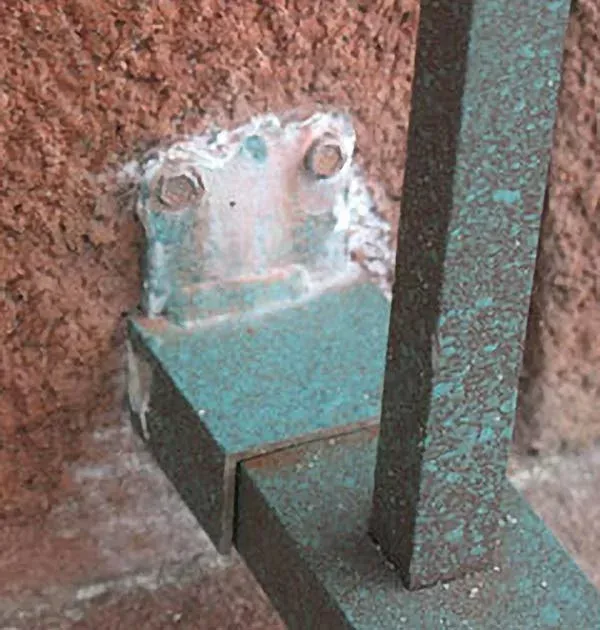
Galvanic corrosion on a railing. While electrolytes exist in just about any environment, but there are exceptions. For instance, in dry or arid climates, galvanic corrosion is unlikely to occur. However, in most climates, moisture finds a way. Condensation forms even in the most watertight systems. This is why most architectural systems contain inner channels for moisture. When water finds a way into your system, you want to give it a way out, too.
When Galvanic Corrosion is a non-issue
Remember how we said that sometimes galvanic corrosion is a non-issue? In some cases, this bimetallic corrosion rate is negligible.
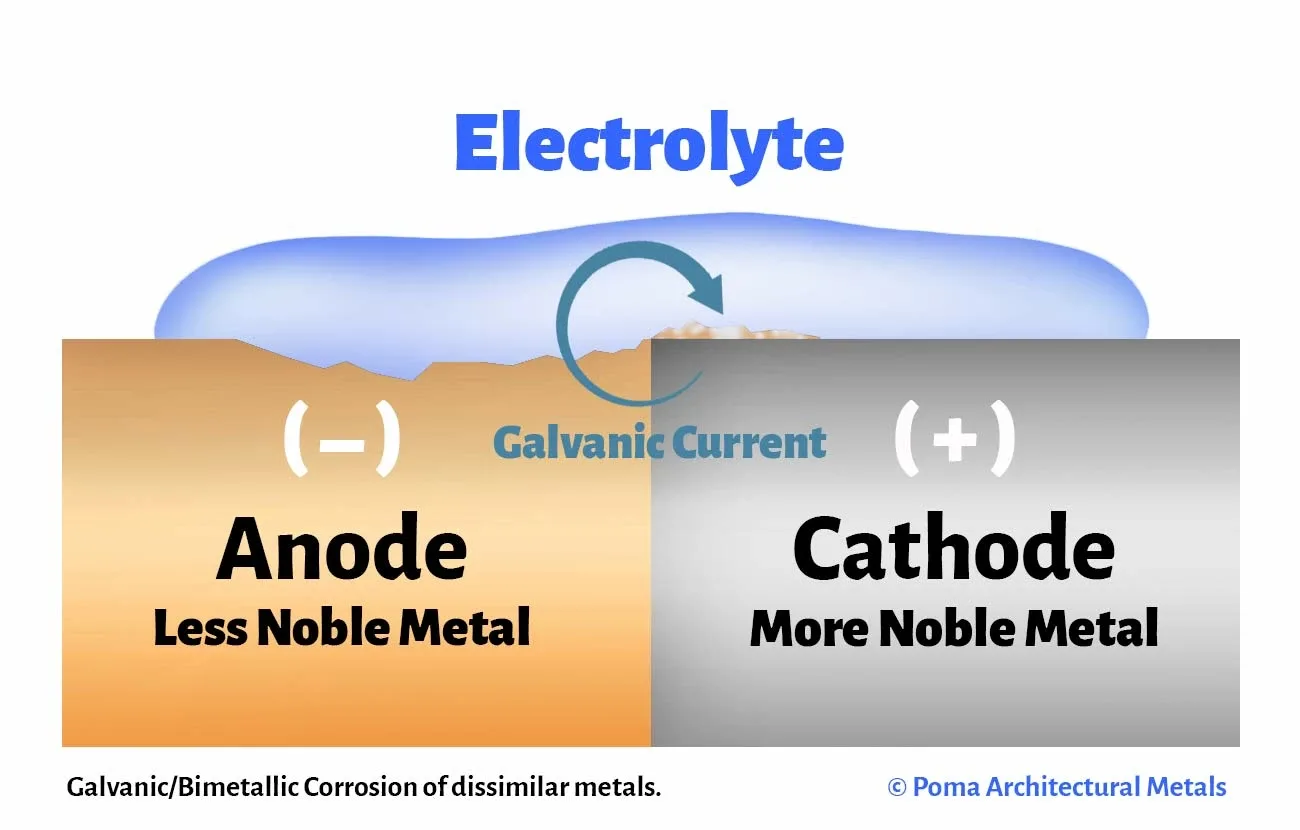
Galvanic Corrosion Graphic — Anodic metals sacrifice to cathodic metals in a galvanic current. For instance, metals with a slight voltage difference will exhibit almost no corrosion when paired. Aluminum and zinc sit very close on the nobility chart above. The electrical difference creates a weaker current. The corrosion is negligible. Another example: If two metals each have large surface areas, very little breakdown will present on the surface. Let's say you've got a thick sheet of stainless steel sitting on top of a thick sheet of aluminum. Or a heavy aluminum tube connected to a stainless steel bar (see our Poma Pin). In each of these cases, the corrosion rate slows down to a crawl. This is because the large aluminum area spreads out the attack,. It has a thick skin, literally.
When Galvanic Corrosion is a BIG issue
This brings us to where galvanic corrosion matters most, because the opposite is also true. When small anodic metals touch a large cathode, corrosion occurs at a much higher rate. You might even say that galvanic corrosion matters most when it comes to smaller metal components.
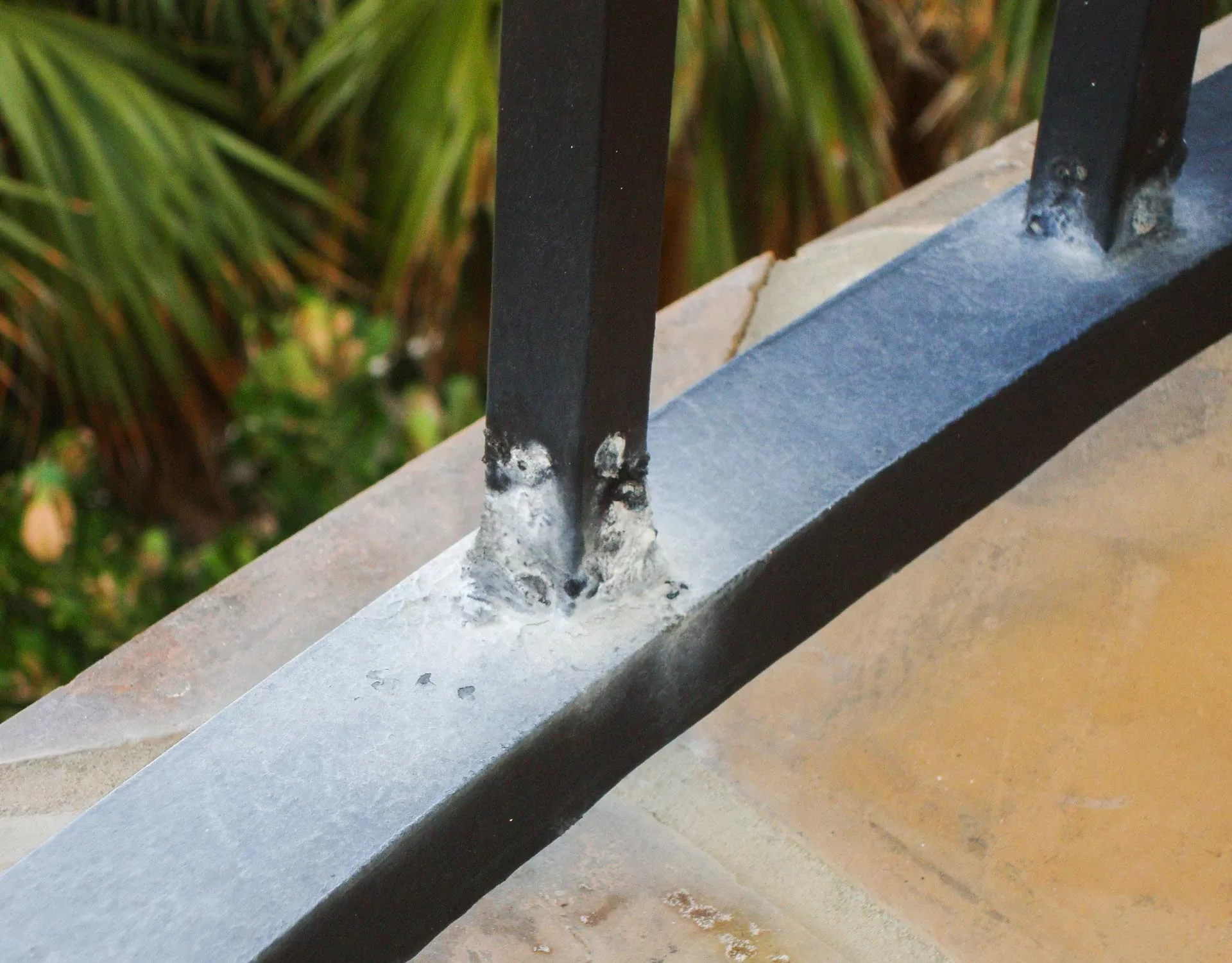
Example of galvanic corrosion due to improper anchor screw metal selection. For instance, let's say you're building a stainless steel facade fastened with screws. If you select zinc-coated screws, the stainless steel will corrode the zinc with aggression. This is because the zinc-coated fasteners get attacked from every direction. Since anchors play such a vital role, this can cause structural failure. In addition, the white corrosion and rust trails will bleed down your building's skin in the process. Not pretty. Therefore, the only time you would use zinc-coated fasteners on metal, is if your metal is the same or similar nobility. For instance, aluminum is close to zinc on the galvanic series, so it won't exhibit much corrosion. Finally, to completely stop corrosion, choose matching metal anchors. Zinc on zinc is a pretty safe bet.
What is the Minimum Distance between Metals to avoid Galvanic Corrosion?
Under normal conditions, galvanic corrosion only occurs when metals make contact. But in some situations, a galvanic current may form at greater distances. In a study published in the Journal for American Water Works Association, researchers tested electrically insulated pipes for corrosion distance. They varied the distances of lead and copper tubes which were isolated by a plastic coupling. Even at twelve inches apart, the tubes exhibited a galvanic current at 20% of the typical corrosion rate.

Learn what we mean when we say Architecture Deserves Quality. To be clear, this is not a common condition. This pertains specifically to piping for MEP systems. For most architectural uses, you won't insulate the metals and run water between them. For galvanic corrosion to occur under most conditions, the materials must either be touching or fractions of an inch apart.
Gravity Matters: How moisture direction affects bimetallic corrosion
There are two reasons why you might want to consider the direction of water flow on a system. First, when moisture flows down from one metal to another, this can increase the odds of galanic corrosion. For instance, sometimes copper crystals will move down as small deposits onto the metal below. This in turn increases the potential area of corrosion. If the copper is migrating onto a cathode, such as stainless steel, there's little risk of additional corrosion. But if the copper migrates onto an andode such as steel or aluminum, you might see additional corrosion. Second, when metals corrode, they bleed. While this might seem obvious, water typically moves downward, and takes any loose bits of corroded metal with it. When designing systems, specify anodic metals downstream of cathodic materials. As an example, Poma owns a patented aluminum and stainless steel railing system. (See the Poma Pin.) In this system, the aluminum post is mounted above a stainless steel pin anchor. By doing this, we reduce downstream potential for increased galvanic corrosion. If some of the aluminum corrodes onto the stainless steel, it's pretty easy to clean.
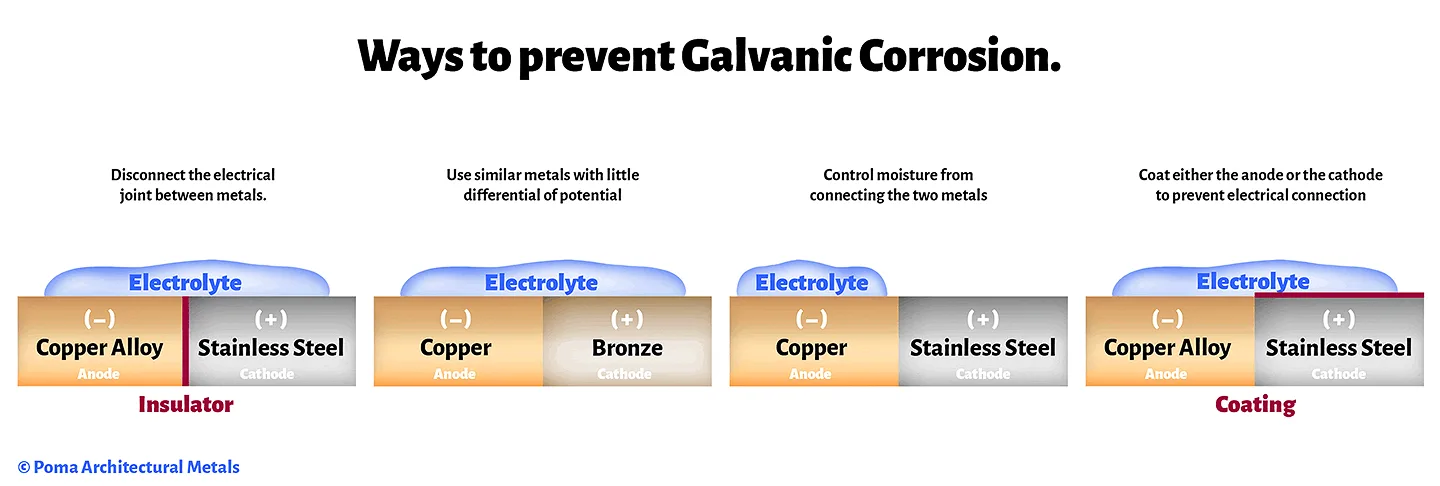
Prevent galvanic corrosion. Four examples of when galvanic corrosion is unlikely to occur.
Surface Finish Matters: How Coatings can reduce corrosion
Remember that galvanic corrosion only occurs when an electrolyte completes the circuit. So let's look at how coating the metal can reduce this breakdown. Anodized aluminum is one way to break the circuit and thus prevent galvanic corrosion. When you anodize aluminum, it forms a thick coating made up of aluminum oxide. This protective layer is a thousand times thicker than aluminum's natural oxide. Even though it's only a 1/10th of a millimeter, this barrier breaks the circuit and prevent corrosion. Paints and/or coatings can also provide some protection against galvanic corrosion. But note that both anodization and paints have a weakness. If the coating wears away or becomes scratched, the metal could rapidly decay. For instance, say that your installer drills holes through the coated material. Doing so will expose the metal, and invite corrosion.
How to Reduce and Prevent Galvanic Corrosion
Let's recap. To reduce or prevent galvanic corrosion, consider each of these strategies:
- Use similar metals. Metals close together on the nobility scale corrode less than metals further apart. Pair metals with similar voltage differences together. Brass and bronze go together; aluminum and zinc make a decent pair; and so on.
- Avoid contact with water. Moisture contains electrolytes, which can create an electrical current between the metals. If you can prevent water from becoming trapped in your system, you will reduce the likelihood of galvanic corrosion.
- Size matters. Avoid small base metals against large noble metals. Screws and other small anchors made from base metals will corrode when mounted to a larger noble metal.
- Break the circuit. If you can break the electrical current between the metals, you'll reduce corrosion. Use plastic/rubber gaskets, paint/anodize the hardware. Remember to coat the parts after fabrication. Pre-drill any holes before coating the material to avoid exposing the base metal.
- Work with gravity. If your system uses dissimilar metals, consider placing the cathode downstream of the anode. This will prevent additional galvanic corrosion from occuring on the lower elevation material.
We hope you enjoyed this article. As suppliers of coastal rail systems, we replace a lot of failed railing systems. In the process, we've encountered some of the worst examples of corrosion imaginable. And most of the time, these guardrail failures could have been easily prevented through proper installations. It's our goal to educate our clients so that you make the best possible design decisions. If you have any questions, don't hesistate to reach out to our team. And make sure to subscribe to our email list and follow us on social media below. We'll continue sharing great educational pieces and amazing project examples. We believe that architecture deserves quality, and we hope you do, too.